Showing posts with label Pym. Show all posts

Tuesday, June 02, 2015

Teaser Tuesdays: Some Tame Gazelle


This week, in honor of Barbara Pym's birthday (she was born June 2, 1913 / and died in 1980) I thought it would be fun to take my teaser lines from one of her books. It's hard to choose -- I love everything she wrote. And it's very hard to limit myself to two sentences. So I'm just using the opening lines from her first book, Some Tame Gazelle:
The new curate seemed quite a nice young man, but what a pity it was that his combinations showed, tucked carelessly into his socks, when he sat down. Belinda had noticed it when they had met him for the first time at the vicarage last week and had felt quite embarrassed. Perhaps Harriet could say something to him about it. Her blunt jolly manner could carry off these little awkwardnesses much better than Belinda's timidity. Of course, he might think it none of their business, as indeed it was not, but Belinda rather doubted whether he thought at all, if one were to judge by the quality of his first sermon.
One of the most interesting things about the book is that even though it tells the story of two middle-aged spinster sisters and was published in 1950, Pym wrote it when she was quite a young woman -- in fact, she began writing it while she was still a student at Oxford in the 1930s. Many years later, she and her sister Hilary ended up living together in an arrangement similar to that of Belinda and Harriet Bede in the book. If you've never read anything by Barbara Pym and would like to sample something, Some Tame Gazelle is probably the most typical and accessible of all her works. And it's a lovely read.


Teaser Tuesdays is hosted by Jenn at A Daily Rhythm. If you'd like to read more teasers, or take part yourself, just head on over to her blog.

And please feel free to leave me a link to your Teaser Tuesday post in your comment here.


Tuesday, June 01, 2010

A-Z Wednesday: "Q"

A-Z Wednesday is hosted by Vicki at Reading At The Beach. To join in, just visit her blog for the guidelines and leave your link in a comment.

This week's letter is "Q." So I went to my shelves, and this is what I pulled out.

Quartet in Autumn
Written by Barbara Pym
Published 1977


Description from the publisher:
In 1977 England rediscovered one of her best living writers: Barbara Pym. Readers and critics alike acclaimed her new novel, Quartet in Autumn, as a major work by an important writer. Quartet in Autumn was the first new Barbara Pym novel to be published in sixteen years. After over a decade of being shunned by publishers as "out-of-date," Barbara Pym was once again a fashionable author.

Written at a time when the author had given up hope of ever being published again, Quartet in Autumn is the softly compelling story of human dignity in the midst of hopelessness. The novel presents us with Edwin, Norman, Letty, and Marcia, four elderly single people who work in the same office. Their work is their chief point of contact with each other and with society in general. The two women retire, an act that threatens the lives of all four.

Lovingly, poignantly, satirically - in the gentlest but sharpest way - Barbara Pym guides us through the lives of her four protagonists and shows us the facade they erect to defend themselves from the facelessness of the welfare state. Seemingly hopeless, their story is also optimistic, and even funny at times. Out of the tragic material of old age, Barbara Pym has made a beautifully constructed, almost musically perfect tale, told in revolving order from four points of view. It is the story of the subtle triumph of human dignity over the threats of solitude and death.
The book's page at Library Thing here.

The book's page at Wikipedia here.

And a few more covers, including some foreign editions:

I'm a huge Barbara Pym fan (I just might have mentioned that once or twice before), and Quartet in Autumn is possibly my favorite of her novels (it's hard to choose just one). It was short-listed for the Booker Prize, and helped establish Pym's reputation as a major 20th Century writer. I first read it during the 1980s and fell in love with all the quirky characters. I've reread it several times over the years, and although the subject matter sounds depressing and dull, it never fails to lift my spirits. Today, I'm much nearer in age to the protagonists than I was when I first read the book, and I'm wondering what my reaction would be now. I guess it's probably time for another visit.

Oh, and by the way, Barbara Pym just happens to have been born on June 2, 1913.

Tuesday, May 11, 2010

A-Z Wednesday: "N"

A-Z Wednesday is hosted by Vicki at Reading At The Beach. To join in, just visit her blog for the guidelines and leave your link in a comment.

This week's letter is "N." So I went to my shelves, and this is what I pulled out.


No Fond Return of Love
Written by Barbara Pym
First published 1961


Description from the dust jacket:
Dulcie Mainwaring . . . is one of those "excellent women" who is always helping others and never looking out for herself – especially in the realms of love. She has a fondness for Ovaltine and a maxim to go with it: "Life's problems are often eased by hot milky drinks."

At a "learned conference" she meets a fellow researcher with an air of some refinement – Viola Dace – and the alluring, absentminded Professor Aylwin Forbes. Dulcie subsequently becomes Viola's landlady, as well as guardian and housekeeper for her own young niece Laurel. Then Laurel becomes the object of Aylwin's amorous designs, and Viola's early passion for Aylwin fades into a more mundane affair.

The novel climaxes in a delicate tangling of schemes and unfulfilled dreams when Dulcie and Viola take a trip to Eagle House in Taviscombe, on the seacoast in the West Country, to discover the hidden secrets of the Forbes clan and the role played in their destiny by a mysterious castle on the hill.

As in all of Pym's novels, the prose is honed to a wry, deadpan perfection. Life's little humiliations are finally put into their place, and the reader sees that things do fall out correctly; love is returned, and fondly, after all.
The book's page at Amazon.com.

The cover of my old paperback edition:


The cover of another, more recent edition:


English novelist Barbara Pym is probably my favorite "modern" writer, and No Fond Return of Love is one of her wittiest and most representative novels. If you haven't read Pym, you're denying yourself some really wonderful literary pleasure. I would always recommend beginning with the early works (especially Some Tame Gazelle, and Excellent Women), but every one of her books is a delight and you can jump in anywhere.

Thursday, October 22, 2009

Booking Through Thursday: One Question

This week, BTT asks a question about questions: If you could ask your favorite author (alive or dead) one question … who would you ask, and what would the question be?

Interesting. Well, I've got several "favorite" authors, and it's hard to choose just one. So I'll go with a couple of favorite authors and a couple of nagging questions. Best I can do. How's that?

I don't know that there's any single question I'd ask her, but I'd love to have a conversation with Barbara Pym. Probably wouldn't talk lit-ra-chure, though. More likely to chat about fashion, pet pussycats, and local gossip. Maybe exchange a few recipes. Have a couple of G&Ts in the garden. That would be great fun.

Also not exactly a single question – but I'd like to find out who wrote all those Shakespeare plays. Was it really the actor Will Shakespeare who lived in Stratford? The one who's buried in Trinity Church there? And I'd love to hear what he has to say about his will, his wife, and all that "second best bed" business. Slap in the face? Or richly symbolic?

And while we're on the subject of literary mysteries, I guess I'd probably want to ask Charles Dickens how he intended to finish his final novel, The Mystery of Edwin Drood, even though he's not exactly a favorite of mine. But as a mystery lover, I always like to have the loose ends tied up, the secrets revealed, and the culprit getting his (or her) comeuppance.

Photos of Shakespeare and Dickens: Wikipedia's Wikimedia Commons.
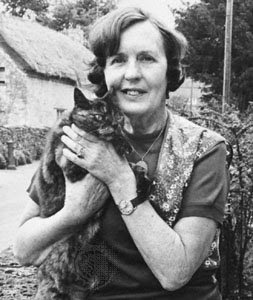
Photo of Barbara Pym is from the book A Very Private Eye: An Autobiography in Diaries and Letters, edited by Hazel Holt and Hilary Pym (E.P. Dutton, 1984).

Thursday, June 25, 2009

Booking Through Thursday: Hot!

This week's BTT question is a tough one:

. . . what is the most “Summery” book you can think of? The one that captures the essence of summer for you? (I’m not asking for you to list your ideal “beach reading,” you understand, but the book that you can read at any time of year but that evokes “summer.”)

At first I thought it would be difficult for me to come up with one book that "evokes summer" – that is, a book with a summery feel to it. Actually, the first thing that came to mind was Barbara Pym. Since I'm a confirmed Pym fanatic, and I first discovered her work during a summer trip to England back in the early '80s, her books usually do make me think of summer.

Then there are all those books I first read during summer vacations when I was a child. I was introduced to Huck Finn and Tom Sawyer and Nancy Drew during the summer. And I spent one whole summer enthralled by everything Arthurian after reading T.H. White's The Once and Future King. But then, I think I read Lord of the Flies during a summer vacation, too; and that certainly doesn't seem very summery. Well, I suppose you could see it as the ultimate example of the summer camp experience gone horribly awry.

But if I'm going to choose just one book that always represents summer in my mind, it would probably be Alice in Wonderland. Not that I read it during the summer, but because of the story of its creation. It was supposedly on July 4, 1862, that Lewis Carroll invented the tale for Alice Liddell while taking her and her sisters rowing. Also, the book is prefaced by a poem that begins "All in the golden afternoon / Full leisurely we glide" and it ends with Alice and her sister sitting in the grass, thinking about the "happy summer days." See? Perfect summer book. In fact, it might be time for a quick re-read this summer.

Thursday, December 04, 2008

Booking Through Thursday: 5 For Favorites

This week's BTT topic is favorite/least favorite authors:

1. Do you have a favorite author? / 2. Have you read everything he or she has written? / 3. Did you LIKE everything? / 4. How about a least favorite author? / 5. An author you wanted to like, but didn’t?

I guess the first three questions are pretty easy for me. Yes, I have a favorite author – Barbara Pym. Yes, I've read everything she wrote; or at least, everything that's been published. I'm assuming, like all writers, she left a stash of material that's never been released; and I keep hoping for a new posthumous publication to come along. But it's been almost thirty years since Pym died, so I suppose it's probably an empty hope.

Yes, I've liked everything I've read.


After Dear Barbara, my favorite author would probably be Anthony Powell. And I've read almost everything he wrote. I think there might be one novel (or possibly two) I haven't gotten to yet, and I believe they've published his journals now. Haven't read those. He was a little more prolific than Pym, so there's more to tackle. And I've liked everything I've read by Powell, as well.


As for authors I don't like – yeah, I'm sure I've got quite a few. But I don't think I could single out any one least favorite. Among present-day writers, there are some really awful examples out there – so narrowing it down that much would be difficult. And authors I've wanted to like, but didn't? Again, lots of candidates: James Joyce and William Faulkner prominent among them.

Hmmmm. It seems both my top favorite writers are Brits (oops, sorry – English). You'd think I could find a fellow American to list, now wouldn't you?

Friday, February 29, 2008

Booking Through Thursday: Heroine

This week's BTT topic:
Who is your favorite female lead character? And why? (And yes, of course, you can name more than one . . . I always have trouble narrowing down these things to one name, why should I force you to?)

Looks like I'm a bit late, as usual. And this is a really tough question. I guess my absolute favorite female heroine would have to be Alice from the Lewis Carroll books – she was a very early literary love, and I still re-read those books frequently. I also enjoy Barbara Pym's women; but in her case, it's the type of heroine I'm responding to, rather than any single character. And Miss Marple will always be a favorite, too – I love the way she's always not what she seems.

I'm beginning to appreciate Elizabeth Bennet more now, after seeing the mini-series on PBS - in fact, that show has inspired me to re-read the novel. I like her sense of humor and the way she stands by her family even though they don't always seem to deserve such loyalty. Have to say, when I first read Pride and Prejudice in high school, I thought Lizzie and Darcy both were boring beyond belief. Interesting what a difference a few decades can make! And recently I've discovered a new favorite in Nancy Clark's The Hills At Home – its main character Lily Hill seems a bit like a modern Lizzie who's grown old and never got to marry her Mr. Darcy.

But I suppose my earliest favorite "literary" chick was Lulu Moppet. She's funny, resourceful, courageous, honest, and loyal, has lots of exciting adventures, and her hair is never out of place. Hate to admit that my love of reading was sparked in large part by a comic book character, but it is the truth. And the fact that I have a large Little Lulu collection squirreled away must mean that she still has a place in my heart.

Wednesday, January 23, 2008

Review: Civil To Strangers

Written by Barbara Pym
Published by E.P. Dutton, 1987

Edited by Hazel Holt


I first learned about Barbara Pym back in the early 1980s, probably not long after she died. In those days, it was still rather difficult to find her books in this country. But M. and I spent the summer of 1982 in England, and I picked up a couple of her novels at Blackwell's in Oxford - I believe they were Some Tame Gazelle and Jane and Prudence. And from the opening sentence of that first book ("The new curate seemed quite a nice young man, but what a pity it was that his combinations showed, tucked carelessly into his socks, when he sat down."), I was hooked.

As rapidly as possible, I acquired and devoured all the novels then in print. I became a Pym fanatic, even going so far as to execute my own Pym pilgrimage on a later England trip – visiting places she'd lived and her old college in Oxford (St. Hilda's). It helped that M. had become almost equally enthusiastic about her books, and indulged my whim. In fact, we liked the books so much, we started forcing them on friends and colleagues – sort of forming our own little Barbara Pym fan club for a time.

While I was reading the novels, I discovered A Very Private Eye, the "Autobiography in Diaries and Letters," edited by her sister Hilary Pym and Barbara's friend and literary executor, Hazel Holt. It was a wonderful, fascinating look at the woman behind the novels – I read it quickly and have re-read it many times since.

And after that, the darkness. Or so it appeared for a time, anyway. I'd read all the novels and the autobiography, and it seemed like that was all there was to be. Barbara Pym had died in 1980 – I would just have to content myself with re-reading her ten wonderful books (sniff).

Well, I needn't have felt so bereft – there were more works to appear, posthumously: the novels Crampton Hodnet and An Academic Question, and then a collection of pieces, including the novel Civil to Strangers. And of course, I gobbled them all up immediately – all of them, that is, except Civil To Strangers. For some reason, I was keeping that one in reserve. Saving it up – like a fine wine or the last bon-bon in the box. Just knowing that there was one more Pym out there to be discovered gave me a nice comforting, hopeful feeling.

And then the Winter Reading Challenge came along, and I said, "why not?" and pulled out my last Pym. Dear Barbara.

Although not published until after her death, Civil To Strangers was actually the second novel Barbara Pym wrote – in 1936 when she was twenty-three, after the first version of Some Tame Gazelle was rejected by several publishers. And as Hazel Holt says in her introduction, it has "all the confidence of youth."

The novel is the story of Cassandra Marsh-Gibbon and her novelist husband Adam who live in the Shropshire village of Up Callow; and as the dust jacket says, "both the village and Cassandra's marriage are thrown into upheaval when a mysterious Hungarian moves into town." And I'm not going to give away much more than that. But the story of Cassandra and Stefan Tilos, and whether they will or won't (or have or haven't) run off to Budapest together, is just the central narrative around which a number of other tales are woven. And all the familiar Pym character types are represented – the Rector and his family; Mr. Paladin the very eligible young curate; the aging bachelor Mr. Gay and his spinster niece Angela, who are "still hoping that there was a rich woman or an eligible husband in the town whom they had somehow missed in their search."

Barbara Pym has often been compared to Jane Austen (unfair, I think, to both authors), and this is probably the most Austen-like of all her books. In fact, I was a little surprised at first at how little it seemed to resemble the later novels. But after a few chapters, the familiar Pym voice started to emerge and I realized that it's actually one of her most comic works. Only Barbara Pym could have written lines like these:

"Holmwood is let," said Mrs Gower in tones of satisfaction, "and to a foreigner!"
"Oh!" Mrs Wilmot gasped. "Are you sure it's true?"
"Oh yes," Mrs Gower replied. "I saw him coming down the drive. Quite dark and wearing a black hat."
"Really . . . " mused Mrs Wilmot, a smile stealing over her eager little face. After the black hat there could of course be no doubt.
[Chapter 5, p. 43]

or,

"I daresay he is going to Birmingham," said Mrs Gower, still on the subject of Mr Tilos.
"Yes, perhaps he is," said Mr Gay lazily. "Let us be thankful that we are not going there."
[Chapter 18, p. 121]

or,

"Science is weaker than Nature," said Adam positively. He looked as if he were about to quote Wordsworth, but Cassandra stopped him in time. [Chapter 25, p. 169]

And the whole of Chapter 14, where all the characters come together for a bridge party and get to know their newly arrived foreign neighbor for the first time, is absolutely perfect Pym. Hardly anything happens, but it's quietly hilarious just the same.

The novel is included in a collection (under the title Civil To Strangers and Other Writings) along with several more works also unpublished at the time of Pym's death. They're all worth reading, of course; and the final piece, "Finding a Voice," is especially interesting to those of us who are under the Pym-ish spell. It's a transcription of a radio program she did for the BBC in 1978, part of a series by well-known writers speaking about how they found their own personal writing styles.

In her introduction to the collection, Hazel Holt says Pym was "pleased to be asked to contribute [to the program], since it was a confirmation at last of her position as a professional writer." In the BBC talk, Pym asks if it's enough just to write for oneself if nobody else is going to read it. And she comes to the conclusion that, though she might not go on writing if absolutely no one were reading, so long as a few people are there "to spur me on," she'll go on: "So I try to write what pleases and amuses me in the hope that a few others will like it, too."

And I'm so glad she did go on. But what am I going to do now that I've read my last Pym? Start at the beginning and read them all again, I suppose. Because there's no one quite like her.

Dear Barbara.

(For an introduction to Barbara Pym and her work, you can visit the "Official Web Site" of the Barbara Pym Society at http://www.barbara-pym.org/.)

Winter Reading Challenge 2008