So I guess things didn't turn out exactly the way I would have liked in the Virginia and Maryland primaries yesterday. But I'm not despairing – the race is still pretty much neck and neck, and we've still got Texas and Ohio to look forward to.
One nice development was that M decided to back Hill, too – at least that's what he's telling me. For a while it looked like we'd cancel each other out, since he was leaning toward Obama.
But even though the election contest might not be going my way, I finally managed to pick a winner at Westminster. Uno the Beagle won Best in Show last night and saved the day from being a total washout. Finally a beagle in the spotlight – take that, you nasty poodles!

Wednesday, February 13, 2008

Monday, February 11, 2008
Booking Through Thursday on Monday
Even though I always find it interesting, I can't seem to remember to check out the BTT web site every Thursday. Last week's topic:
"But Enough About Books - Okay, even I can’t read ALL the time, so I’m guessing that you folks might voluntarily shut the covers from time to time as well… What else do you do with your leisure to pass the time? Walk the dog? Knit? Run marathons? Construct grandfather clocks? Collect eggshells?"
Well, I do sort of read ALL the time – or at least, I try to do some reading everyday. Other than that, much as I hate to admit it, I guess my major leisure-time activity is watching movies (and old TV shows) on DVD – M and I subscribed to Netflix a couple of years ago so we could catch up on all the films we don't go to anymore. In the last 15 years (since the early '90s), we've gone out to see a movie in an actual theater about half a dozen times. So Netflix has been great for us.
A couple of cousins got me interested in genealogy many years ago, and since then I've spent a shocking amount of time and effort on family history research. It's a great hobby for a former history major. And it's a lot easier now than it was ten years ago, before there were all the online resources we have today.
I don't do sports and I'm not a real artsy-craftsy sort of person, although I am getting the itch to try doing some needlework again. I tried cross-stitch once and just couldn't stick with it – all those little x's over and over and over just got mind-numbingly boring after a while. But I think I could enjoy regular needlepoint or embroidery a little more.
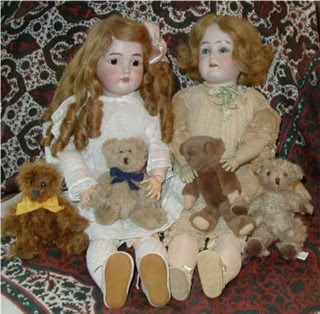
For about a dozen years or so, I was deeply into doll collecting. Nowadays, I don't really collect – I maintain. I still love dolls and enjoy the collection, but I'm not actively buying anymore. The condo just can't hold any more additions. In fact, I may be on the verge of becoming a seller of dolls – could be my new hobby!
"But Enough About Books - Okay, even I can’t read ALL the time, so I’m guessing that you folks might voluntarily shut the covers from time to time as well… What else do you do with your leisure to pass the time? Walk the dog? Knit? Run marathons? Construct grandfather clocks? Collect eggshells?"
Well, I do sort of read ALL the time – or at least, I try to do some reading everyday. Other than that, much as I hate to admit it, I guess my major leisure-time activity is watching movies (and old TV shows) on DVD – M and I subscribed to Netflix a couple of years ago so we could catch up on all the films we don't go to anymore. In the last 15 years (since the early '90s), we've gone out to see a movie in an actual theater about half a dozen times. So Netflix has been great for us.
A couple of cousins got me interested in genealogy many years ago, and since then I've spent a shocking amount of time and effort on family history research. It's a great hobby for a former history major. And it's a lot easier now than it was ten years ago, before there were all the online resources we have today.
I don't do sports and I'm not a real artsy-craftsy sort of person, although I am getting the itch to try doing some needlework again. I tried cross-stitch once and just couldn't stick with it – all those little x's over and over and over just got mind-numbingly boring after a while. But I think I could enjoy regular needlepoint or embroidery a little more.
For about a dozen years or so, I was deeply into doll collecting. Nowadays, I don't really collect – I maintain. I still love dolls and enjoy the collection, but I'm not actively buying anymore. The condo just can't hold any more additions. In fact, I may be on the verge of becoming a seller of dolls – could be my new hobby!
Our Own Super Tuesday
Finally it's our turn - "Potomac Primary" time tomorrow. I'll be out bright and early, and I'm really hoping for a little warmer weather because I'll be walking over to vote.
So, if you live in Virginia or Maryland, go vote! And may the best woman win!
So, if you live in Virginia or Maryland, go vote! And may the best woman win!
Tuesday, February 05, 2008
Review: The Flanders Panel
 Written by Arturo Perez-Reverte
Translated from the Spanish by Margaret Jull Costa
Harcourt Brace & Company, 1994, 295 pages
Winter Reading Challenge 2008
"Life is an uncertain adventure in a diffuse landscape, whose borders are continually shifting, where all frontiers are artificial, where at any moment everything can either end only to begin again or finish suddenly, for ever and ever, like an unexpected blow from an axe. Where the only absolute, coherent, indisputable and definitive reality is death. Where we are only a tiny lightning flash between two eternal nights, and where . . . we have very little time." [Chapter XV: "Queen Ending," p. 269]
Julia, a 20-something art expert in Madrid, is hired to restore a painting about to be auctioned off by Claymore's, a prominent auction house. The Game of Chess, by fifteenth-century Flemish master Pieter Van Huys, depicts the Duke of Ostenburg and one of his knights seated at a chess board, engaged in a game, while in the background a lady in a black velvet dress sits reading by a window.
When she has the painting X-rayed before cleaning, Julia discovers a hidden message in a corner of the work, presumably written and then deliberately painted over by the artist himself. The message is written in Latin: "Quis Necavit Equitem" ("Who Killed the Knight?"), and Julia's obsession with finding out more about the inscription, the picture and the historical events surrounding its creation are the basis of Arturo Perez-Reverte's sophisticated mystery novel, The Flanders Panel.
As she turns up more information about the painting and the characters involved, Julia begins to realize she's uncovered a Renaissance murder mystery that seems to have ramifications in the present century. But even as violence and danger begin to erupt, her fascination with the painting and its story increases until it threatens her own life and the lives of her friends and loved ones.
As the book's advertising claims, The Flanders Panel is truly a "mystery for the connoisseur." The writing is sophisticated and elegant, the plot twists and turns, and the story shifts easily back and forth among many attractive (and yet somehow sinister) settings – auction houses and museums, antique shops and chess clubs, nightclubs and the streets of Madrid. The chess motif is well-researched, and runs through the whole book, but readers who know little about chess (and I'm one) can still enjoy the story.
Images of Alice and her looking-glass are sprinkled through the book – another heroine caught up in a story based on a game of chess. The author throws in several paradoxes and puzzles along the way, and many references to Edgar Allan Poe and Dupin, and to Sherlock Holmes and Watson, I suppose to emphasize the fact that the story is a mystery. And there are surprises (almost literally) around every corner.
This is the second Perez-Reverte novel I've read – the first was The Club Dumas; and I don't think "Flanders" quite comes up to that level. Still, it kept me turning pages into the wee hours, several nights running, and whetted my appetite for more of his work - and I consider that a pretty good recommendation.
Saturday, February 02, 2008
Yet Another Challenge!
 I know I probably shouldn't do it, but this one looks like so much fun. Dewey (The Hidden Side of a Leaf) is hosting the Man Booker Challenge:
"To participate in the Man Booker Challenge, you just choose 6 books that have won the Man Booker Prize, or have been shortlisted or longlisted. They can be from any year. The challenge will run from January to December 2008. . . . You may overlap with other challenges. You may change the books on your list at any time."
There's a list of all the prize winners and some of the short and long lists since 1969 at The Booker Prize Archive. So many of these are books and authors I've been meaning to read, it seems like a challenge that was dreamed up with me in mind. I even find that most of the books I'll be reading are already in my library – obviously just waiting for the Man Booker Challenge to come along and give me a nudge.
Here's my list of six books (subject to change, of course):
Chatterton, by Peter Ackroyd (short-listed, 1987) [See Review]
Hotel du Lac, by Anita Brookner (winner, 1984)
The Master, by Colm Toibin (short-listed, 2004)
The Old Devils, by Kingsley Amis (winner, 1986)
The Road to Lichfield, by Penelope Lively (short-listed, 1977)
Saturday, by Ian McEwan (long-listed, 2005)
My husband thinks these challenges are crazy. But they're keeping me reading, so I'm a believer.
Friday, February 01, 2008
Review: Betsy-Tacy

Written by Maud Hart Lovelace
Illustrated by Lois Lenski
Published by Harper Collins
First published by Thomas Y. Crowell, 1940
Young Readers Challenge 2008
First there was just Betsy Ray, a four-year-old girl with plump legs and brown braids, living with her mother and father and her eight-year-old sister Julia in a small yellow cottage, "the last house on her side of Hill Street," in a town named Deep Valley. But even though there are plenty of other children on Hill Street, there are no other little girls just her age, so when a new family moves in across the street, Betsy is thrilled to find that one of the many children in the family is another little four-year-old girl, named Tacy (short for Anastacia).
Tacy is as thin as Betsy is plump, and her hair is red and curly. At first, the two girls don't hit it off – Tacy is painfully shy ("bashful," as Tacy's older sister Katie always tells people) and it takes a while for the two to get to know each other. But after they do, they become inseparable: "It was difficult, later, to think of a time when Betsy and Tacy had not been friends. Hill Street came to regard them almost as one person." So they became Betsy-Tacy.
Maud Lovelace's Betsy-Tacy is the story of the first year of friendship between the two little girls, with Betsy taking the lead in most of their adventures. Along the way, the girls start school, explore their village, and meet their neighbors. They play paper dolls and dress-up, and help their older sisters color Easter eggs. They climb trees, make snow angels, and turn a piano crate into a playhouse – one of my favorite episodes because I had a similar playhouse when I was about that age, made from a box that a refrigerator came in.
Lovelace combines the reality of their situation with a liberal sprinkling of fantasy, mostly in the form of really magical stories made up by Betsy. In one of their early meetings, the two ride through the sky on feathers and look down on their houses and neighbors below. Well, not really. But Betsy and Lovelace have a way of enveloping both Tacy and their readers in the magic.
Not all of the book is charming fantasy. There's a bit of real-life trauma thrown in. When Mrs. Ray has a baby, Betsy has a little trouble adjusting to not being the youngest member of the family anymore. And there's a death in one of the families, that's very surprising and sad.
Betsy-Tacy is the first of a series of books Maud Lovelace wrote about the two girls and their friend Tib, who makes her first appearance at the very end of this book. According to most histories of the books, Lovelace based the character of Betsy on herself and used incidents in her own life for story lines. The books are set in the very late 19th and early 20th centuries, and are appealingly slow-paced and nostalgic. For many years, it was hard to find the books outside libraries; but the huge cult following that's recently developed has led to new editions being issued.
I'm not sure how this book would go over with youngsters today – it's very old-fashioned and, I suppose, quaint. I've been meaning to read it for years. And now that I have, I'm very happy I finally met Betsy and Tacy, and I'm looking forward to getting to know Tib. But I certainly wish I'd discovered their books as a child – I would have loved them.
You can learn more about Maud Hart Lovelace, and Betsy and Tacy and the books by visiting the Betsy-Tacy Society Home Page.
The View From My Window
 Actually, it's the view from our balcony. First of February. Rainy and cold. Bleak, bleak, bleak.
Of course, if the sun were shining, the view would be lovely.
February is my least favorite month of the year. Nothing good ever came of it. OK - my apologies to George and Abe and Thomas Edison. From my personal viewpoint, only two good things have ever happened in February – my grandmother and my cousin MLB were both born in February.
But mostly, the month is just something to be dreaded and gotten through as painlessly as possible. Fortunately, it's short; although this year it's a whole day longer because of leap year.
On the other hand, Valentine's Day is one of my favorite holidays – it doesn't really fit with the depressing tone of the rest of the month. It's one of my favorites because it doesn't involve my hanging out in the kitchen all day, cooking huge inedible meals. My other favorite holiday is Halloween – for much the same reason. That and the fact that I've always loved dressing up in costumes.
Oh, well, today's a good day for staying indoors and curling up with a good book (or a good blog). And I certainly have a lot of good books stacked up around the place. I guess that's one nice thing about February – the weather usually keeps me from feeling guilty about not being out and about. Maybe we should make February "Stay Indoors and Read" Month. I'd vote for that.
Subscribe to:
Posts (Atom)